

To better understand what it means to have an AI-enabled workflow as opposed to a truly agentic one, we first need to understand the distinction between a chatbot and an agent. While many use these terms interchangeably, they have their own distinct purpose and process flow.
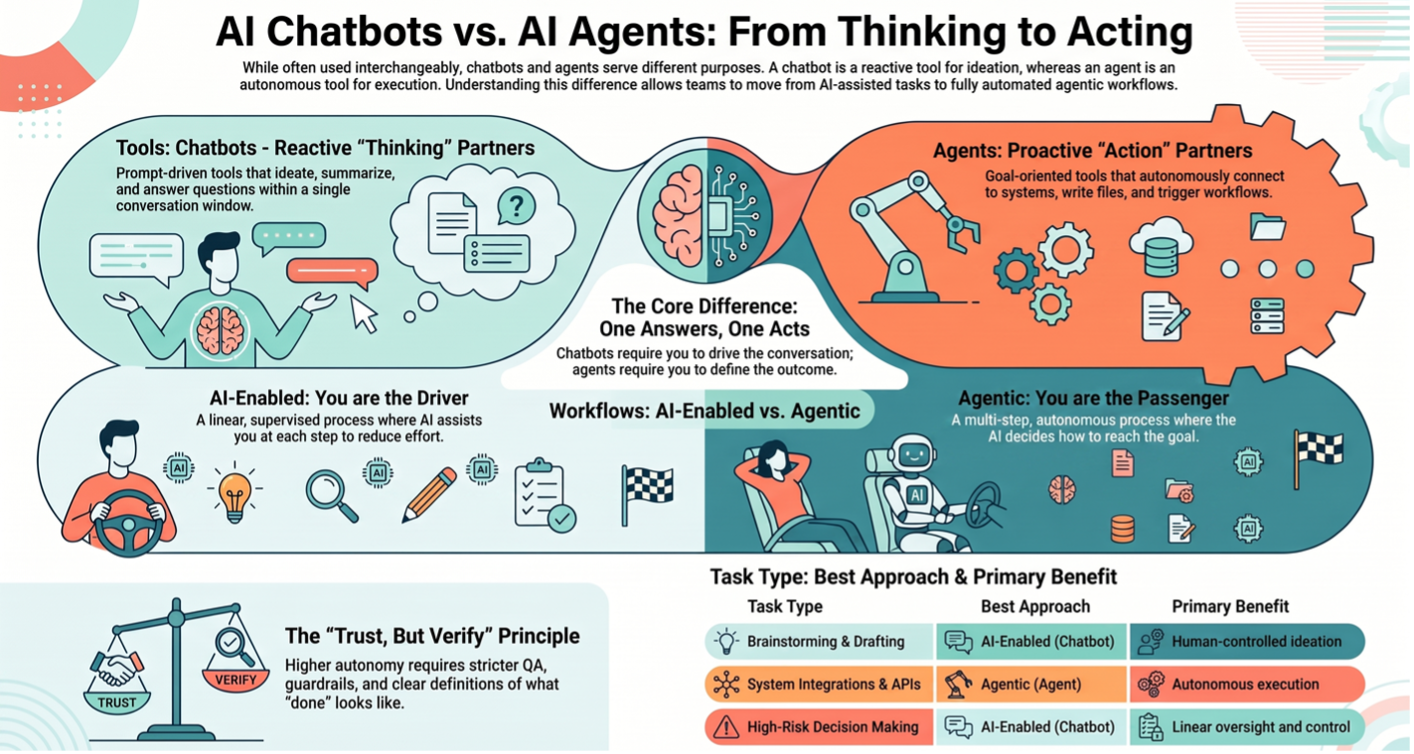
The easiest way to think about this: a chatbot responds, and an agent executes.
A chatbot is reactive and prompt-driven. You ask it something, it answers, and there are no tangible outcomes outside the conversation window. You are the one driving the conversation. Every response is a direct reaction to your input, and the context lives solely inside the chat. The bot will not create files, trigger workflows, or change your systems.
Chatbots are excellent for drafting, brainstorming, summarizing, explaining concepts, and Q&A.
An agent is fundamentally different. You give it a goal, and it will systematically determine the steps to reach a desired output. Agents are tool-enabled, meaning they connect to your systems, which in turn allow them to query, write files, call APIs, and chain actions together autonomously within your system. When interacting with an agent, you define the outcome, not a single question, and the agent will sequence and action its steps to reach a goal.
Agents are excellent for automating repeatable tasks that produce tangible outputs.
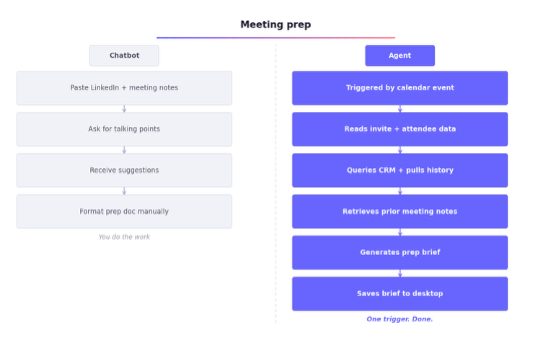
Take meeting prep as an example. Before heading into a client call, you may need structured talking points and context about who you are meeting with.
With a chatbot, you could paste in the client’s LinkedIn profile and the last set of meeting notes, ask for talking points, and get a solid context list back. From there, you take those suggestions, format your own prep document, and pull everything together before the call. The chatbot helped you think. You still did the work.
With an agent, that same outcome looks different. First, you could trigger the agent by opening a calendar invite. After the initial trigger, the agent would take the work from there. It would then read the invite, identify the attendees, query your internal systems for their history, pull your prior meeting notes, and synthesize everything into a single output. A formatted prep brief is then saved to your desktop before the call starts. You defined the outcome. The agent sequenced and actioned each step to get you there.
Now that we’ve defined the difference between a chatbot and an agent, this is where it becomes a little more nuanced. What does it mean to be AI-enabled vs. having a fully agentic workflow?
An AI-enabled workflow is one where a human drives the process and AI assists at each step. You are always in the driver’s seat. The AI can help to draft, summarize, suggest, and even explain how to get from Point A to Point B, but ultimately you are deciding what happens next. Each step and output should be reviewed before moving on. AI-enabled workflows are linear, supervised, and easy to course-correct. These are low-risk and highly controlled processes.
An agentic workflow flips that dynamic. The AI drives the process while you are along for the ride. You set the goal and review the outputs, but the agent is making the decisions in between. Decisions such as individual steps, what to filter on, and how it should build your output to meet your goals. Agentic workflows are multi-step and autonomous. That autonomy is the point, but it also means QA and guardrails matter a lot more.
Sticking to the driving analogy, we can think of an AI-enabled workflow as your daily driver. It is your car and your responsibility to stay within the lines, obey traffic laws, and ensure continued maintenance. On the flip side, we can think of an agentic workflow as having a self-driving car. You still own the process and are accountable when it fails. However, the burden of getting from Point A to Point B falls on the system rather than your ability to navigate the roads.
A useful gut-check: ask yourself who is making the decisions at each step. If it’s you, it’s AI-enabled. If the AI is getting you from Point A to Point B, that’s agentic.
And that’s not a bad thing. AI-enabled workflows are genuinely powerful, and the fact that many teams are already here means the foundation is solid. The question is where to go from here. There’s a difference between slapping on a fresh coat of paint and overhauling the engine entirely. Genuine thought and care must be put into the engine, whereas you can change the paint’s color at any time. At the end of the day, a well-maintained car outperforms a flashy one, and the same is true for your workflows.
The next step for many AI-enabled teams is identifying where the jump to true agentic processes makes sense. For starters, look at and try to replicate highly repetitive and clearly defined tasks that have predetermined outcomes.
The more autonomy you hand to an agent, the more important your QA mindset needs to become. Agents can be wrong without hesitation. The output may appear clean, but you still need to understand the logic behind it.
A few principles worth building into any agentic workflow:
Use a chatbot when you need to think, draft, explore, or understand something. Keep the human in the seat.
Use an agent when you need something tangible built, filtered, generated, or automated with clearly defined outputs and a QA process to match.
If you’re still not sure where to start when designing your first agent, pick the most repetitive task you do every week and ask yourself whether an agent could or should handle it. Creating a single automated task a week will compound quickly. The goal isn’t to automate everything at once. Instead, your focus should be on understanding simple and accurate workflows first, then scaling from there.

Not sure on your next step? We'd love to hear about your business challenges. No pitch. No strings attached.


