

CDOIQ Symposium in Cambridge, MA, is one of the premier gatherings for data leaders. It brings together chief data officers and other technology and analytics decision-makers to discuss the choices shaping the future of data and AI. Rather than focusing on individual technologies, the symposium examines how organizations are evolving their data strategies, governance approaches, and leadership models to navigate an increasingly AI-driven world.
At this year’s symposium, conversations spanned data management, governance, analytics, machine learning, and information quality, but they consistently returned to a broader challenge: how leaders can move beyond isolated initiatives and build the capabilities needed to create lasting value from data and AI.
.jpeg)
Concord sponsored the event and contributed to the conversation through two executive discussions: a panel focused on moving AI from isolated pilots to enterprise-wide scale, and a dinner roundtable exploring the path toward more autonomous organizations. Together, the discussions examined what changes when organizations move from experimenting with AI to integrating it into how work gets done.
Pete Scherf, SVP of Data & AI at Concord, moderated a panel on the mechanics of moving AI from isolated pilots to enterprise-wide scale. The panel featured Radha Kuchibhotla, Lead Director of AI Solutions & Design at CVS Health, and Art Morales, VP of Technology Enabled Science at CSL. Ashish Nachane, VP of Data & AI at David Yurman, shared his perspective ahead of the discussion, and his insights helped shape the conversation throughout.
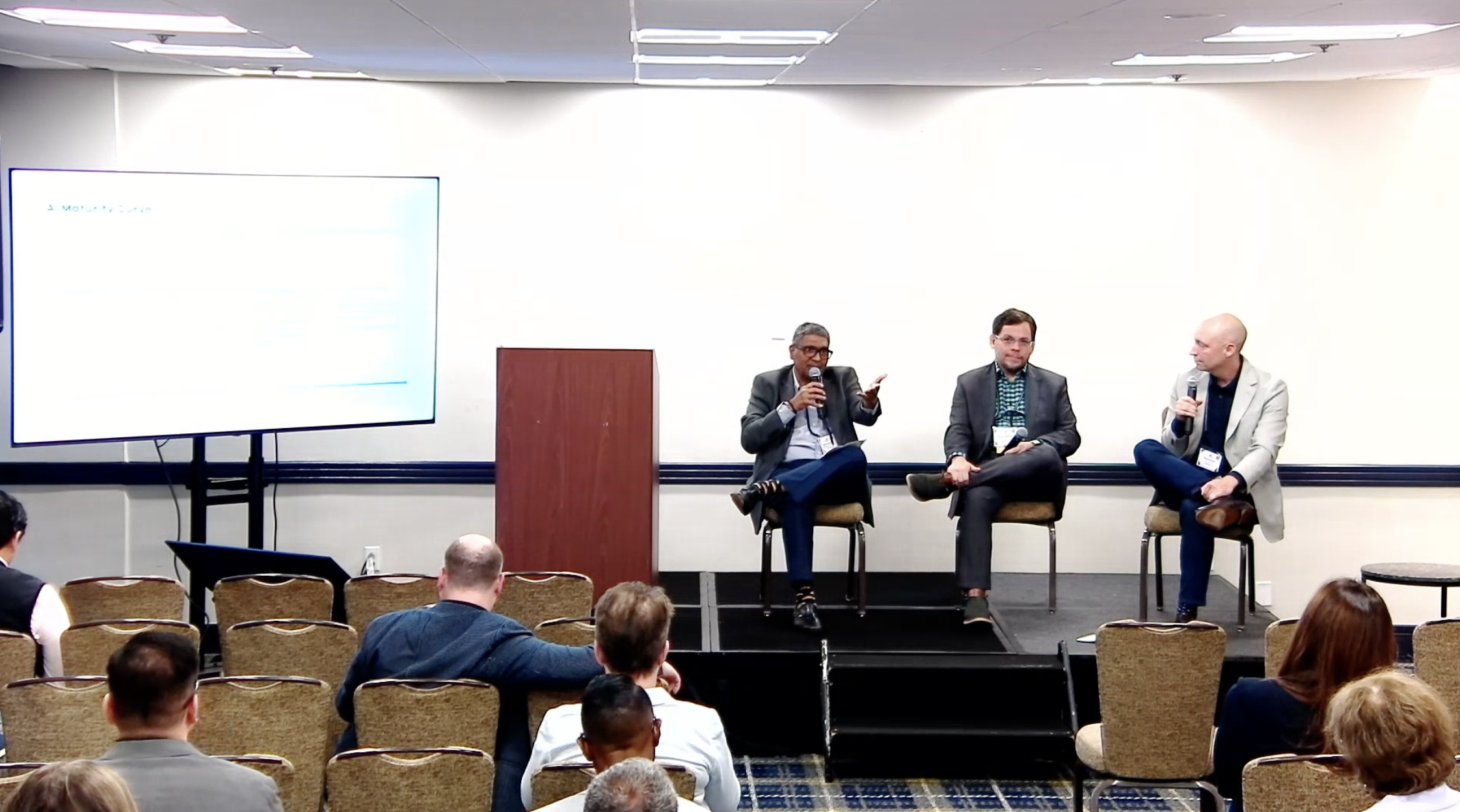
The conversation opened with an AI maturity curve that outlined four stages of organizational progress.
Organizations distribute AI licenses broadly and hope something useful emerges. It often produces excitement for a few weeks before stalling out with little to show for it.
Discrete AI use cases are live and delivering real, local value, but gains don’t roll up. A single team moves faster but work simply piles up at the next stage of the process, keeping overall ROI obscured.
Use cases become connected so an entire workflow moves faster end-to-end. This stage requires process discipline, cross-team coordination, priority alignment, and real observability into agent activities.
Multi-process workflows operate autonomously, and humans shift from executing the work to managing the systems that perform it.
Each panelist shared where their organization sits on this curve, and the conversation explored three areas shaped by their respective experiences.
Ashish centered on a point that came up throughout the conference: meaningful AI initiatives depend on having data "in order" before the technology can deliver value. Rather than treating data readiness as a box to check, the discussion explored what that looks like in day-to-day operations and why it remains a prerequisite for successful AI adoption.
He also walked through a file management use case that served as an early implementation for his team. Starting with a focused, well-scoped problem provided an opportunity to demonstrate value, validate the organization's approach, and build confidence before expanding AI into more complex use cases.
The conversation concluded by looking ahead. With an initial use case in place, the focus shifted from proving AI could work to considering what comes next and whether a broader third stage of adoption is already on the roadmap.
Art explained what happens when an innovation mandate built for speed and experimentation collides with governance. Rather than framing it as innovation versus bureaucracy, the discussion highlighted the reality that successful AI initiatives must balance rapid experimentation with the controls needed to operate responsibly at enterprise scale.
He described what “bounding the SDLC” and staying off autopilot look like in practice, emphasizing that moving fast doesn't mean removing oversight. Instead, it means putting the right guardrails in place so teams can innovate quickly while maintaining security, quality, and accountability.
Art also walked through a build his team completed in weeks instead of licensing a large platform, using it to explore the tradeoffs between building and buying. A fast, purpose-built solution can make sense when solving a focused problem or validating an approach quickly. Larger enterprise platforms become more compelling when capabilities need to scale, integrate across the organization, or support long-term operational requirements.
The discussion also turned to collaboration with enterprise partners. Rather than framing governance as an obstacle, Art explored what it looks like to work together to establish the guardrails that allow innovation to move forward responsibly, making governance and speed complementary rather than competing priorities.
Radha showed what “stringing use cases together” means at a very different scale than a single team or product line. Rather than focusing on individual AI implementations, the discussion explored what it takes to coordinate AI initiatives across a large enterprise, where multiple teams, systems, and priorities have to work together.
He walked through reducing provider onboarding from 90 days to 45 days, emphasizing that the outcome depended on more than improving a single step. Success required the broader process to work together as an end-to-end workflow, demonstrating that enterprise AI creates the greatest impact when improvements extend beyond isolated tasks.
Radha hit particularly hard on targets and measurement in AI. To build credibility and avoid the most common project failures, organizations must measure progress against fundamental business drivers – growth, speed, risk reduction, and cost – rather than inventing AI-specific metrics or relying on storytelling.
The conversation concluded by examining what governance and prioritization look like at enterprise scale. While smaller organizations may focus on proving individual use cases, coordinating AI across a large organization requires aligning initiatives, establishing shared governance, and making deliberate decisions about where to invest and scale next.
The panel closed by asking what guidance leaders would give organizations still working through the early stages of AI adoption.
The answers converged around a practical takeaway: organizations should focus less on chasing new AI capabilities and more on creating the conditions that allow successful use cases to expand. A key insight from the discussion was that today’s enterprise AI is most effective when it is paired with reliable systems and clear business processes. Rather than expecting AI to manage complex operations independently, organizations should use it where it can support decision-making and combine it with deterministic software, explainable ML, and other predictable tools that enable consistent execution.
Ultimately, scaling AI effectively requires a balance between AI’s ability to reason and the control, governance, and architecture needed to operationalize those capabilities. Early success comes down to choosing problems with measurable value, building confidence through focused implementations, and creating the foundation to scale what works.
Concord also hosted a roundtable dinner discussion centered around the idea of the “self-driving organization”: businesses that run substantial parts of their operations through autonomous, coordinated AI agents rather than relying solely on human-executed workflows.
The discussion focused on three areas: the barriers preventing organizations from reaching this level of autonomy, the capabilities required to make it possible, and the ethical responsibilities that emerge as companies move toward more autonomous decision-making.
The group’s discussion of blockers surfaced several distinct challenges, each requiring a different response.
The first challenge is the gap between the processes organizations document and the processes employees actually follow. Automating the documented version can simply encode an idealized version of how the company operates, while overlooking the workarounds that have developed because they compensate for real-world variability.
The takeaway was that process discovery has to come before process automation. Organizations need to understand how work is performed, not just how it appears on a process map.
The discussion also challenged the assumption that every workaround is a failure. In many cases, workarounds exist because employees have adapted to gaps in existing systems.
Rather than eliminating them outright, organizations can treat workarounds as valuable signals about what future systems need to support. They reveal where current processes fail to account for the complexity of real operations.
Another category is less about technology and more about incentives. Resistance to delegating decisions to AI is not always cultural hesitation; sometimes it is a rational response to an uneven risk-reward structure.
The person approving an AI-driven decision may absorb the consequences of an error while receiving limited recognition for the speed or efficiency gained. Changing that equation requires organizations to rethink how accountability and incentives are structured.
The group emphasized that data readiness is not a property of the entire enterprise.
A company may have the data needed to automate a focused decision while still struggling to create a complete, enterprise-wide view of a customer or process. Treating readiness as one large milestone can prevent organizations from pursuing practical opportunities while waiting for challenges that may be much harder to solve.
Underneath these challenges sits a broader structural issue: many liability models still assume that a human decision-maker exists somewhere in the chain.
Organizations that sequence AI adoption based only on technical feasibility may overlook a more important question: what type of risk is involved? A bounded, measurable decision with clear reversibility carries a different exposure profile than decisions involving safety, employment, credit, or health.
The group also identified blockers that rarely appear on standard AI roadmaps: the lack of reversibility for some agent-driven decisions, the coordination layer between departments that often exists through relationships rather than documented processes, and the reality that a handoff between teams is not just a workflow step. It can also represent ownership, budgets, and organizational structures.
The enablers discussed during the roundtable fell into four layers. While technical foundations are necessary, the discussion emphasized that the more difficult challenges often emerge around governance, authority, and decision-making.
At the foundation is a simple question: can a non-human actor take a given action, and can that action be undone if needed?
Many enterprise systems are designed for machines to read information, not execute decisions. Moving toward autonomy requires systems that allow agents to act while maintaining appropriate controls and the ability to recover from mistakes.
Above that sits the organization’s ontology: a shared understanding of what important business concepts mean, such as customers, contracts, accounts, and ownership.
The discussion highlighted that effective AI systems need more than definitions of entities and relationships. They also need context. A close-of-quarter scenario, a customer escalation, or another unique business situation may require different decisions than a standard case.
Authority also matters. Organizations need clarity around which systems, roles, or agents can assert certain facts and make certain decisions.
The third layer is what the group described as an agent “society”: an environment where agents can work together based on shared expectations.
That requires more than a directory of available agents. Each agent needs:
The final layer is steering, and the discussion highlighted this as one of the hardest challenges.
Giving an AI system a goal is not enough because goals often fail to capture the tradeoffs organizations make every day. What needs to be defined are the exchange rates: how much margin the organization is willing to trade for retention, how much delivery risk for cost, and how much precision for speed.
Making those tradeoffs explicit often reveals disagreements that were previously implicit.
One of the most practical takeaways from the discussion was that scaling autonomous decision-making is not primarily a compute challenge. It is a human review challenge.
The important metric is not simply how many agents an organization has deployed, but how many decisions can move forward without human review, measured by decision type and risk level.
The roundtable closed with a discussion of what autonomous organizations owe the people affected by them. The conversation organized these questions into three categories: who captures the gains and bears the transition costs, what organizations owe people during direct interactions, and by what authority companies make decisions.
The discussion noted that the third category often receives the most institutional attention because compliance functions are already structured around it, while the first two are more often addressed through principles rather than operational mechanisms.
On the transition-cost question, the group highlighted an accounting asymmetry worth considering: training and retraining costs are typically treated as expenses, while automation investments are often treated as capital investments. That difference can influence investment decisions before broader questions about workforce impact are fully considered.
On what organizations owe people during direct interactions, the group made an important distinction: people do not always need a human for warmth. Often, they need discretion. They need access to someone with the authority to depart from policy when a specific situation produces an unreasonable outcome.
Removing every point of human discretion from a process does not remove the need for judgment. It removes the mechanism through which that judgment can be applied.
Across the broader conference, the same idea appeared repeatedly: successful data and AI transformation depends less on technology alone and more on the organizational foundations that allow it to create value.
A cross-industry governance study presented at CDOIQ found that formal data governance programs are widespread, but their effectiveness depends on human coordination, clear ownership, and the ability to translate frameworks into everyday operating practices. A banking case study from KeyBank explored how organizations can move from fragmented data capabilities toward a coordinated foundation built on governance decision rights, measurable quality standards, data literacy, and clear ownership. A session on higher education data leadership reinforced the evolving role of CDOs in translating organizational priorities into strategic direction, while a discussion on moving from data-driven to data-inspired organizations highlighted that transformation requires cultural change as much as technical capability.
At Concord, we help organizations turn the promise of AI into measurable business value by strengthening the foundations that make intelligent systems work. From data strategy and governance to AI solutions and operating models, we partner with leaders to move beyond experimentation and build the capabilities required to scale AI responsibly. Because the organizations that will benefit most from AI won’t simply be the ones that adopt the technology first. They’ll be the ones that are prepared to put it to work.

Not sure on your next step? We'd love to hear about your business challenges. No pitch. No strings attached.


