

As we explored in our last post, Google’s recent search result updates, particularly SERP compression, have significantly reshaped visibility for even the most authoritative websites. Now, AI is taking this evolution further by transforming how search works, how content is discovered, and how analytics drives actionable insights. In this AI Discovery Era, analytics is no longer just a scorekeeper; it is the system of truth for discoverability. It helps brands understand what’s findable, what’s credible, and what actually converts.
Google’s SERP compression is part of a larger transformation: AI is reshaping the mechanics of discovery itself. From Bard to Gemini to Microsoft Copilot, generative systems are redefining how consumers “search.” Instead of scrolling, they are asking and increasingly trusting machines to synthesize the answer for them.
For SMEs, this introduces a new frontier: AI-first SEO, where visibility depends not only on ranking, but on being recognized as an authoritative entity that AI systems can cite.
To compete effectively:
This mirrors the enterprise AI adoption story we explored in Doing Enterprise AI Right: transformation isn’t driven by technology alone, but by strategy, governance, and adaptive operating models. The companies that learn to signal authority to AI will define the next era of discoverability.
The AI Discovery Era calls for discovery analytics, a discipline that extends traditional SEO measurement into AI-driven environments. Think of it as three concentric circles:
Each layer requires distinct analytics strategies:
Concord’s analytics practice is already integrating these layers into unified dashboards, helping clients see beyond what Search Console reports and measure true discoverability.
Consider a regional fashion retailer competing against global e-commerce giants.
Before AI-driven discovery, their SEO strategy targeted hundreds of long-tail phrases like “linen wrap dress for summer brunch” or “ethical jewelry under $100.” These ranked on pages two to four, driving modest but steady traffic.
After AI-driven discoverability became central, impressions collapsed. Instead of retreating, they rebuilt their analytics approach:
Despite losing 40% of “visible” impressions, click-to-conversion rates increased 28%, and organic revenue climbed year-over-year. Visibility didn’t shrink — they learned to measure differently.
Google’s SERP compression and AI-driven discovery can feel limiting, but constraints often create focus. This mirrors the experimentation mindset outlined in Experimentation as a Growth Engine in Retail & E-Commerce: leaders thrive not by running more tests, but by designing the right tests that isolate meaningful behavioral signals.
SMEs can apply the same logic to discoverability:
1. Test for Intent Fit, Not Just Keywords
Use analytics to identify which search intents convert best, then align content, messaging, and product positioning around those high-value intents.
2. Personalize at Scale
Apply behavioral data to dynamically tailor landing experiences for organic visitors, turning fewer impressionsinto higher conversion efficiency.
3. Experiment Continuously
Treat discoverability as an iterative system. Use A/B and multivariate testing to refine messaging, metadata, navigation, and content architecture over time.
Every constraint is an invitation to optimize. When visibility is scarce, precision becomes your advantage.
Concord’s approach to analytics in the post–long-tail era draws from our enterprise frameworks in AI, personalization, and experimentation. Together, these form a repeatable system for turning visibility constraints into strategic advantage.
Here’s the flywheel we recommend:
Integrate Search Console, GA4, social signals, referral sources, and AI citation data. Capture behavior, not just clicks.
Break down silos between marketing, commerce, CRM, and product analytics. This unified foundation enables journey-level insight instead of channel-level noise.
Use machine learning to uncover patterns between:
This reveals where discoverability drives revenue, not just traffic.
Shift from volume publishing to high-intent, analytics-informed storytelling, the same principle behind Concord’s personalization model, which prioritizes relevance over reach and measurable business outcomes over impressions.
Treat each click as the start of a relationship. Test dynamic landing experiences that adapt to user behavior in real time.
Repeat this cycle quarterly. Over time, analytics becomes not just a reporting layer, but a competitive advantage.
Traditional SEO KPIs is giving way to a new hierarchy of metrics designed for compressed SERPs and AI-driven discovery environments:
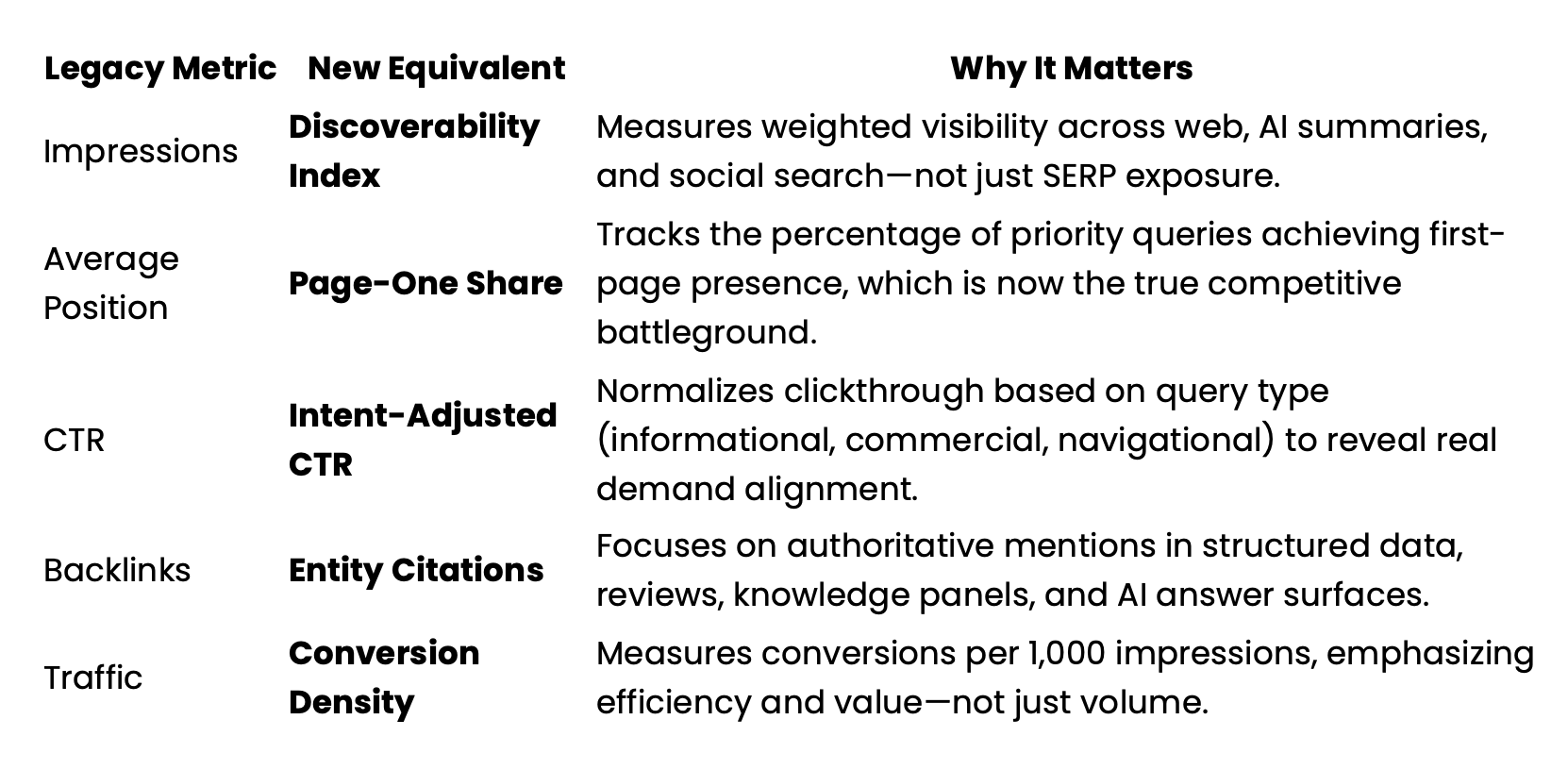
These KPIs align directly with Concord’s philosophy of outcome-driven analytics: less noise, more signal, and measurable business impact.
At Concord, we help organizations bridge the gap between algorithm changes, AI evolution, and business clarity. Our analytics accelerators and AI-powered frameworks help SMEs:
In other words, we turn algorithm volatility into a structured advantage.
Search is no longer a list of blue links. It’s a conversation between users, content, and AI. Google’s shift from infinite pages to focused results signals that discoverability has entered its next phase.
For SMEs, success hinges on a simple equation:
Visibility = Data × Intent × Trust
Analytics is the multiplier — the bridge between what you publish and what your audience finds. When Google narrowed its results, it didn’t shrink opportunity. It spotlighted precision.
The businesses that win the next era of discovery will be those that combine data fluency, AI literacy, and creative empathy — the same attributes that define Concord’s approach to digital transformation.
Let us help you redefine your strategy to stay seen. Contact us today!

Not sure on your next step? We'd love to hear about your business challenges. No pitch. No strings attached.


