

Retailers are facing a tougher growth environment, but they're not necessarily cutting back on investment.
In Concord's Loyalty Growth Playbook, which draws on insights from 150 retail and consumer-durables leaders, 63% of respondents said economic conditions had become more challenging in 2025, while 64% expected marketing budgets to increase in the next fiscal year.
That raises an important question: Where do retailers see the best opportunities to grow?
The answer increasingly lies with existing customers. When asked about their biggest opportunity to increase customer revenue over the next year, loyalty and retention were far and away the top choice, followed distantly by cross-selling/upselling and expansion into new customer segments.
The findings point to a greater emphasis on strengthening existing customer relationships. While acquiring new customers remains important, retailers are looking for ways to drive repeat purchases, strengthen engagement, and increase customer lifetime value.
Of course, keeping those customers is easier said than done. Shoppers can compare prices, explore alternatives, and switch brands with relatively little effort. Retailers need to give them compelling reasons to return, and those reasons increasingly extend beyond traditional loyalty programs.
Points, discounts, and rewards have long been central to retail loyalty programs. They still have a role to play, but our research suggests retailers see the broader shopping experience as an important factor in keeping customers engaged.
When asked what customers value most, 40% of retail leaders selected convenience and ease of experience. Fast and reliable delivery followed at 35%, while 16% chose personalized recommendations and engagement. Only 6% selected the lowest price.
Certainly, price hasn’t stopped influencing purchasing decisions, but it does suggest that retail leaders see significant value in making shopping easier and more dependable.
Consider the experience surrounding a purchase. Customers need to find the products they want, complete transactions, receive orders on time, and resolve issues when something goes wrong. Friction at any of these points can affect whether they choose to return.
That has implications for how retailers approach loyalty investments. A new rewards tier may encourage engagement, but improvements to checkout, fulfillment, or customer service can also make a meaningful difference in the overall experience.
The playbook explores this through the concept of loyalty ecosystems, which bring together rewards, customer data, digital experiences, commerce, and service. Rather than managing loyalty as a separate program, retailers can use these connections to create more consistent experiences across channels.
A customer might receive a relevant offer based on previous purchases, access loyalty benefits during checkout, and receive personalized service without having to repeat information. When these interactions work together, loyalty becomes part of the everyday shopping experience rather than something driven primarily by incentives.
AI is giving retailers more ways to understand customer behavior and tailor experiences to individual preferences, and many are already putting these capabilities to work. We’re seeing a big jump in leaders who report using AI for email marketing and personalization, alongside applications in content generation, demand forecasting, inventory management, analytics, and search.
These applications support more relevant customer engagement. Retailers can use purchase history, browsing activity, product preferences, and other behavioral signals to inform recommendations, identify opportunities for cross-selling, and adjust communications based on customer activity. But getting useful results depends on having a reliable view of the customer.
In many retail organizations, customer information is distributed across ecommerce platforms, CRM systems, loyalty applications, point-of-sale technology, and marketing tools. Each system may hold a different piece of the customer relationship. A commerce platform might contain transaction history, while a loyalty application tracks rewards activity and a CRM stores service interactions.
If those records aren't connected or customer identities aren't consistently matched, personalization efforts can rely on incomplete information. That leads to irrelevant offers, inconsistent messaging, and missed opportunities to respond to customer needs.
Connecting these sources gives retailers a more complete view of customer behavior and makes it easier to coordinate experiences across channels. It also creates a stronger foundation for AI applications that depend on accurate, timely information.
A retailer could use connected purchase and engagement data to identify customers who may be losing interest, recommend products based on previous behavior, or reduce promotions that are no longer relevant. These use cases require more than selecting an AI tool. Retailers need dependable data pipelines, consistent customer identifiers, appropriate governance, and integration between the systems involved.
As AI becomes more widely used in retail, the quality and accessibility of customer data will play an increasingly important role in determining how effectively organizations can personalize experiences.
Retailers are investing in loyalty and digital experiences, but Concord's research highlights several challenges that limit the impact of those investments. One of the clearest examples is mobile commerce. While retail leaders expect mobile to play a significant role in future growth, mobile and online experiences were also identified as the largest sources of friction in the customer journey.
If customers struggle with navigation, checkout, account access, or loyalty redemption, adding more personalized offers may do little to improve the overall experience. Retailers need to address those underlying issues alongside their loyalty initiatives.
Technology complexity presents another obstacle. In Concord's survey, 39% of respondents identified technology stack complexity as the biggest barrier preventing marketing teams from achieving their goals, with budget limitations and fragmented data also among the leading challenges.
These findings help explain why delivering connected customer experiences can be difficult, even when retailers have the right strategic priorities. Marketing teams may have access to loyalty platforms, personalization tools, analytics applications, and customer data systems, but those technologies don't automatically work together.
Disconnected platforms can make it harder to maintain consistent customer profiles, coordinate campaigns, measure engagement, and understand how different interactions contribute to revenue. Addressing these challenges may require retailers to simplify existing technology environments, improve integrations, and establish more consistent ways to manage customer data.
Measurement is another important consideration. Loyalty program enrollment and rewards redemption provide useful indicators of participation, but retailers also need to understand whether those programs are contributing to repeat purchases, customer retention, revenue, and customer lifetime value.
Connecting loyalty activity with commerce and customer data can help teams evaluate those outcomes more effectively. With marketing investments facing greater scrutiny, retailers need to demonstrate how improvements to customer experience translate into business performance.
Retailers have significant growth potential in strengthening existing customer relationships, but turning that opportunity into results requires more than investing in loyalty programs or adding new technology. Retailers need to understand where customers are experiencing friction, how well their existing systems work together, and which improvements will have the greatest impact on retention and long-term growth.
Concord helps retailers put those priorities into practice through customer data integration, digital experience modernization, analytics, and AI. Our teams work with organizations to address the technology challenges behind customer loyalty and create more connected, consistent shopping experiences.
For a deeper look at the findings and recommendations, explore Concord's Loyalty Growth Playbook.
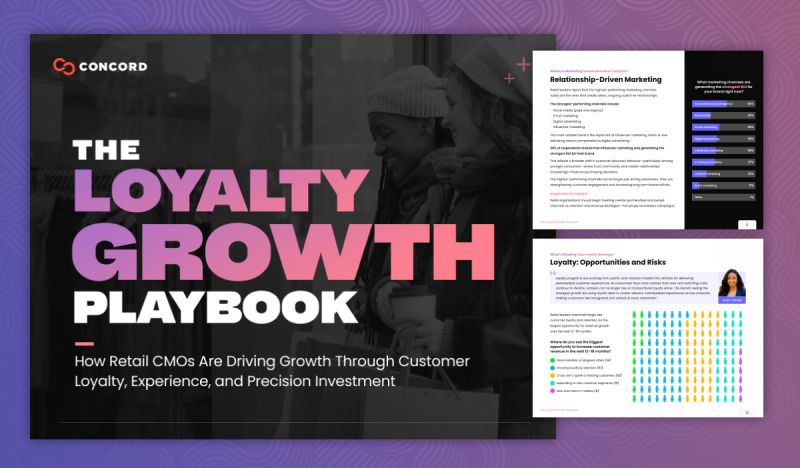
Looking to strengthen customer loyalty and retention? Connect with Concord to discuss how we can help turn your retail priorities into measurable results.
Retailers are looking for ways to grow revenue while navigating economic pressure and changing customer expectations. In Concord's survey of 150 retail leaders, loyalty and retention ranked as the largest opportunity to increase customer revenue over the next 12–18 months.
According to Concord's research, 40% of retail leaders identified convenience and ease of experience as the most important factor, followed by fast and reliable delivery at 35%. Personalized recommendations and engagement ranked at 16%, while lowest price came in at 6%.
AI can help retailers analyze customer behavior, improve product recommendations, personalize offers, and identify opportunities to increase engagement. These applications depend on reliable customer data and integration across retail systems.
Technology stack complexity, fragmented customer data, and friction in digital experiences can make it difficult to deliver consistent customer interactions. Concord's research found that 39% of retail leaders identified technology stack complexity as their biggest obstacle to marketing performance.

Not sure on your next step? We'd love to hear about your business challenges. No pitch. No strings attached.


