

Marketing teams generate more data than ever before. Campaigns produce metrics. CRM systems collect lead information. Analytics platforms track customer behavior across channels. Turning that information into action remains a challenge.
Much of the day goes to reviewing reports, evaluating test results, prioritizing leads, and auditing campaigns. This work is essential, but it is also repetitive and time-consuming.
AI assistants are starting to change that. Rather than replacing marketers, they help teams analyze information faster and automate routine tasks, so people can spend more time on strategy and execution. Three use cases are emerging as particularly valuable:
With the right governance and human oversight, AI assistants can meaningfully reduce manual effort in each of these areas.
An AI assistant is a software system that uses AI to analyze information, answer questions, and generate recommendations through natural language. They can support a range of marketing activities, including:
In many organizations, AI assistants are becoming a bridge between data and decision-making.
While both technologies can improve efficiency, they operate differently.
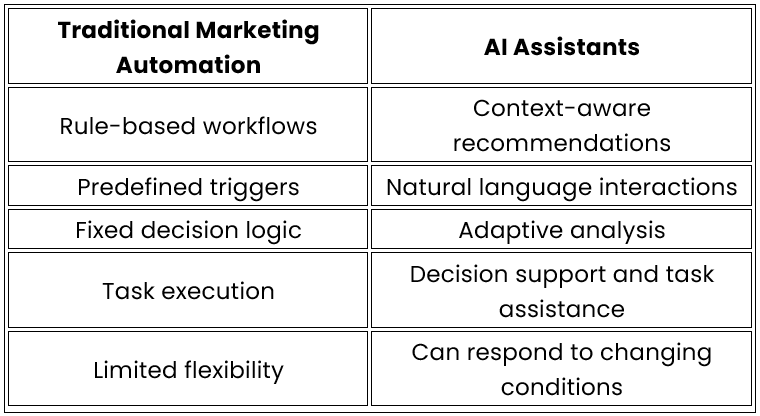
Unlike traditional automation tools, which follow predefined rules, an AI assistant can interpret context and respond to open-ended requests like: “Which campaigns are generating the highest conversion rates?” or “Which leads should sales prioritize this week?”
This makes them particularly useful for analysis-heavy, continuously optimized workflows.
Several factors are driving adoption:
Organizations evaluating AI adoption typically start by identifying workflows, such as reporting, lead prioritization, or campaign optimization, where AI can improve speed and decision quality. From there, they align that work with broader business objectives.
As testing programs scale, reviewing results and identifying winners becomes a bottleneck. The challenge isn’t collecting data. It’s analyzing it fast enough to act on it.
AI assistant can review testing data and flag statistically significant outcomes. Instead of digging through dashboards, markets can simply ask:
A team running multiple landing page experiments asks which active tests show the strongest conversion gains. The AI assistant reviews performance data and identifies statistically significant winners. It then returns a prioritized list of recommended actions, turning hours of report review into a concise, actionable summary.
Traditional lead routing relies on static rules, such as territory, company size, industry, or form fields. These rules automate distribution, but they miss real-time engagement signals. Two demographically similar leads can receive identical treatment despite having very different buying intent.
AI assistants widen the lens by factoring in website activity, content engagement, email interactions, CRM history, and lifecycle stage. The question shifts from “Who owns this lead?” to “Who should engage this lead next, based on current behavior?”
Two prospects submit identical demo requests. One has attended webinars, revisited pricing pages, and engaged with recent emails. The other has shown minimal activity. An AI assistant flags this difference and recommends a different follow-up strategy for each, surfacing context the routing rules alone would have missed.
A thorough campaign audit means pulling data from analytics platforms, ad accounts, CRM systems, and email tools. These often live in fragmented reporting environments, and reconciling all of it by hand consumes hours that could go toward fixing the problems it reveals.
AI assistants can analyze this data directly and answer questions like:
A marketing leader wants to know why performance dipped last month. Instead of pulling reports from five systems, they ask the AI assistant directly. It reviews approved data sources and identifies likely causes, then returns a prioritized list of recommendations. The team spends its time evaluating and acting, not gathering.
A/B testing, lead routing, and campaign auditing share a common profile. They are data-rich, repeatable, measurable, and outcome-oriented, which is exactly where AI assistants add the most value. As adoption grows, expect similar patterns to show up in customer experience, revenue operations, analytics, and content operations.
Getting these workflows right requires clean, connected data, the right governance, and a team that knows how to measure results. Concord helps marketing organization build that foundation, from data integration to AI consulting to ongoing performance measurement, so AI-assisted workflows deliver outcomes you can actually point to on a dashboard. Connect with us to learn more.

Not sure on your next step? We'd love to hear about your business challenges. No pitch. No strings attached.


