

The “build vs. buy” dilemma shows up in decisions more often than we realize. It’s there when you decide to cook from scratch or order takeout. It’s there when you choose to buy land and build a custom home or go with something move-in ready.
Different contexts, same underlying tradeoff: How much time, effort, and expertise are you willing to invest to get exactly what you want, and how much convenience, speed, and simplicity are you willing to pay for instead?
That same dynamic is playing out across enterprise AI as organizations decide whether to build their own AI capabilities or buy them through third-party platforms.
Neither approach is inherently wrong. The real work is figuring out where each approach makes sense.
Every technology leader faces two primary strategic trade-offs when charting their AI roadmap:
The decision to build typically starts with selecting a foundation model. Today, a growing number of powerful models are available under genuinely open-source licenses with no commercial restrictions. Qwen 3 from Alibaba, Mistral's model family, and DeepSeek R1 are all released under Apache 2.0 or MIT licenses, meaning there are no usage caps and no licensing fees. Google's Gemma and AI2's OLMo offer similar freedom.
This is a meaningful shift. Just two years ago, most capable models came with restrictive licenses that limited how organizations could use them in production. Today, the foundation layer is effectively free. The competitive advantage no longer comes from accessing a model. It comes from what you build around it.

When you build an AI asset, you own the intellectual property (IP) on every custom layer: your data pipelines, your fine tuning, your evaluation framework, and your domain specific goal. The base model may be open source, but what you build on top of it is yours alone. In a hyper-competitive market, relying entirely on commercial APIs means your software capabilities are identical to those of your closest competitor. A custom-built AI engine acts as a permanent differentiator, transforming your unique operational data into an asset that cannot be easily replicated or copied.
For enterprises operating in highly regulated fields like healthcare, defense, or banking, data security is non-negotiable. Building your AI infrastructure ensures that sensitive data never leaves your internal, controlled environments. This self-contained setup isolates your corporate intelligence from third-party ecosystems, eliminating the risk of data leakage or compliance failures.
Commercial software is built for the masses, which means it addresses broad, generalized use cases. Building allows for deep tailoring. The resulting AI tool integrates perfectly into highly specific, complex, and legacy internal business workflows. It conforms precisely to your operational nuances rather than forcing your teams to alter their processes to fit a vendor’s rigid software design.
On the other side of the spectrum, buying means subscribing to turnkey software-as-a-service (SaaS) platforms, enterprise commercial APIs, or managed solutions offered by tech giants like OpenAI, Microsoft, Google, or Anthropic.

The speed of AI evolution is relentless. Building a system from scratch can easily require six to twelve months of development before delivering a stable release. Buying bypasses this entirely. Enterprise deployment takes days or weeks instead of months or years, allowing organizations to capitalize on market opportunities immediately.
AI research is unpredictable. Experiments can fail, models can underperform, project scope can expand, and timelines can easily spiral out of control. Purchasing a third-party license eliminates this R&D risk. It provides highly predictable software costs while shielding your budget from the premium, fluctuating salaries commanded by AI engineers.
When you buy from a dedicated AI vendor, you are not just purchasing their current software; you are buying their future innovation roadmap. The third-party provider assumes full responsibility for backend infrastructure maintenance, model updates, security patches, hardware scaling, and immediate bug fixes. This frees up your internal IT teams to focus entirely on core business operations.
To determine the ideal path for your next AI project, evaluate your specific operational constraints against this strategic decision matrix:
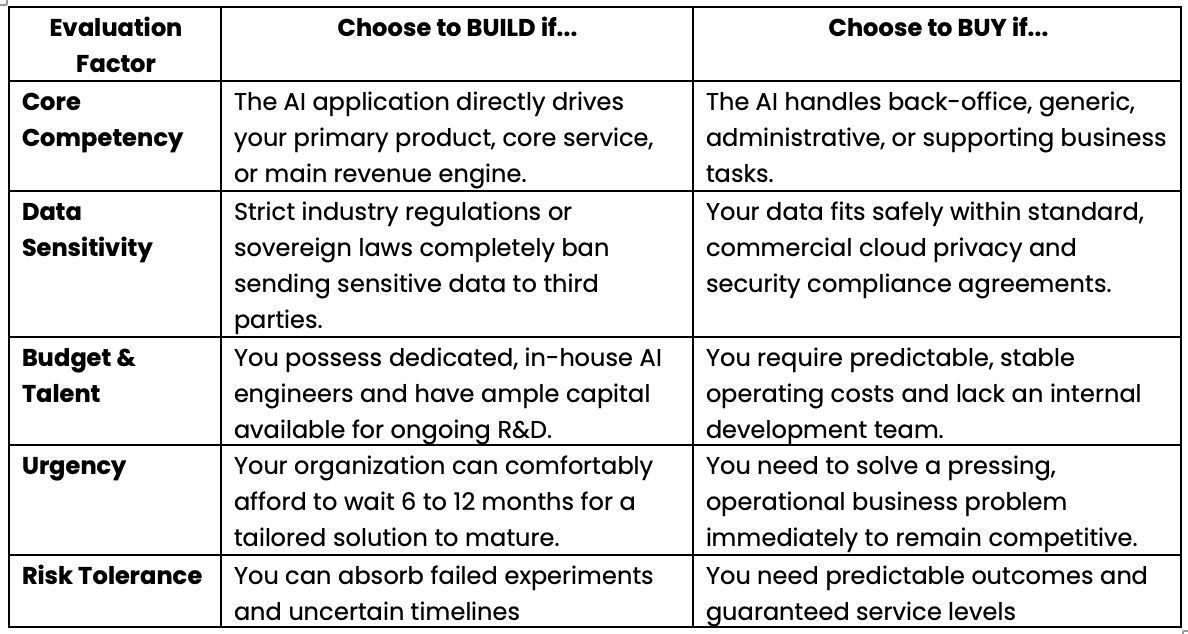
Most organizations look at this matrix and find they don't sit cleanly in one column. Some use cases call for building, others for buying. That tension isn't a problem to solve. It's the starting point for a smarter strategy.
For most modern enterprises, choosing a pure "build" or pure "buy" strategy is a false dichotomy. Forward-thinking organizations are increasingly adopting a middle ground known as the "Buy and Customize" hybrid approach.
Instead of reinventing the wheel, companies purchase access to foundational model infrastructure via APIs or deploy optimized open-weights models on standard cloud servers (the Buy layer). They then build custom layers directly on top of this rented foundation using techniques like Retrieval-Augmented Generation (RAG) and targeted fine-tuning (the Build layer).
This hybrid methodology captures the rapid deployment speed and reduced infrastructure costs of buying, while retaining the deep customization, unique data protection, and competitive advantage of building.
There is no one-size-fits-all answer to the build vs. buy dilemma. A single enterprise might choose to buy a standard customer service chatbot tool while simultaneously investing millions to build a proprietary predictive analytics engine for its core product line. The secret lies in accurately mapping each use case to its strategic value.
To help establish the ideal, custom roadmap for your next corporate initiative, consider these final three guiding questions:
If you are currently evaluating your options, let me know us thoughts on these three operational factors. Concord can help you talk through these complex architectural decisions, evaluate your team's constraints, and find the hybrid path that is exactly right for your business. We provide the robust foundational infrastructure you need so your team can focus on building the proprietary logic and data differentiation that truly sets you apart.

Not sure on your next step? We'd love to hear about your business challenges. No pitch. No strings attached.


