

For decades, software has followed a simple model. A user takes an action. The system responds. Click a button. Submit a form. Trigger a workflow. The logic runs exactly as programmed. The output is predictable because the inputs are predefined.
This paradigm powered web applications, SaaS platforms, enterprise systems, and automation tools. It created efficiency by reducing human labor. But it was never intelligent. Traditional software executes. It does not reason.
Today, that limitation is becoming visible.
Organizations are drowning in workflows that require human intervention between every step. Automation scripts break when conditions change. Integrations fail when inputs deviate from expected formats. Business processes stall because someone must interpret context before the next action.
The problem isn’t a lack of automation. It’s that automation still requires constant supervision.
That’s why a new architectural model is emerging: agentic architectures – systems designed not just to execute instructions, but to evaluate context, makes decisions, and determine the next best action before acting.
Over the past two decades, architectural advances such as microservices, APIs, and workflow engines have improved scalability and flexibility. But they still assume predictable inputs and deterministic flows. Modern business environments are messy:
Customer requests are unstructured. Support tickets contain nuance. Healthcare records include narrative notes. Sales conversations require interpretation. Traditional systems struggle because ambiguity requires judgment.
Predefined process maps fail when real-world variation appears. A missing field. An unexpected dependency. A regulatory update. Each deviation requires human intervention or engineering changes.
Most enterprise systems don’t lack connectivity. They lack reasoning. Humans are inserted between steps because systems cannot evaluate tradeoffs, assess context, or decide dynamically. That manual layer is where time, cost, and risk accumulate.
An agentic architecture is a software design paradigm in which systems are built around autonomous agents capable of reasoning, planning, and acting based on goals rather than fixed instructions.
Instead of following hard-coded workflows, agentic systems determine what to do next based on context and objectives.
In practice, this means software can:
Traditional automation follows rules: “If X happens, then do Y.”
Agentic systems operate differently: “Given this goal and this context, what should I do next?”
That shift from rule-based triggers to objective-oriented system behavior is foundational.
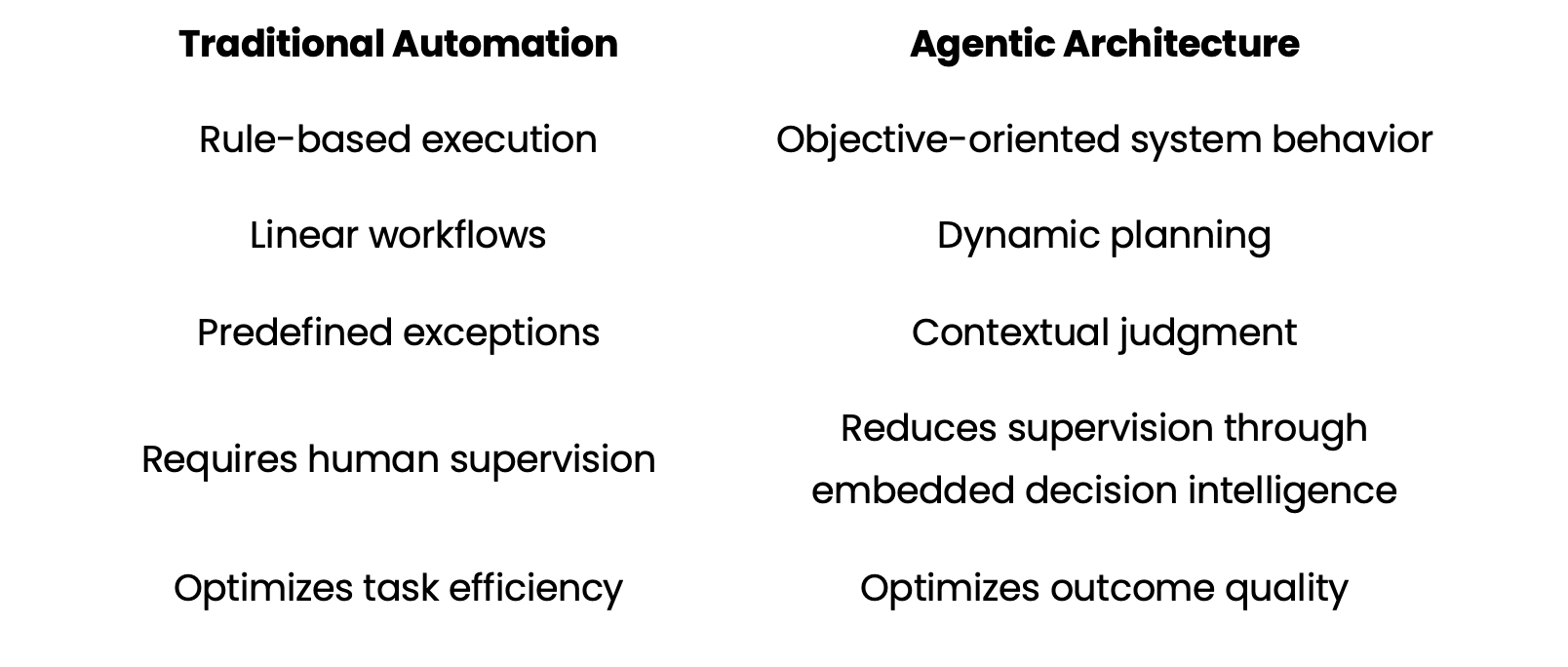
Understanding what an agentic system is helps, but what does it really mean for software to think before acting? In practice, agentic systems operate differently from traditional automation in three fundamental ways:
Traditional workflows move in straight lines. Agentic systems branch, reassess, and replan. They don’t assume the first step is always correct.
Automation requires engineers to anticipate edge cases. Agentic systems interpret new situations without needing predefined branches. They generalize instead of enumerating.
Humans no longer micromanage every step. Instead, they:
The agent handles execution within constraints. This moves humans from operators to supervisors.
Agentic software is not magic. It is built from identifiable architectural layers that work together to enable adaptive behavior.
Goal → Context → Reasoning Engine → Action Layer → Reflection Loop
↑_________________________________________________________↓
This continuous feedback loop enables adaptive behavior under changing conditions.
Every agent operates toward an explicit objective. For example:
The goal is not a step. It is an outcome.
Agents continuously gather relevant inputs, including:
This allows them to operate with awareness, not isolation.
This layer interprets context and determines next actions. Modern language models and planning algorithms power this capability. They evaluate multiple possible steps before executing one. The system pauses to think. That pause is the breakthrough.
Agents can trigger APIs, update records, send communications, initiate workflows, or escalate to humans. But actions follow reasoning, not rigid scripts.
Agentic systems evaluate outcomes. If a result fails or context changes, they adapt. This feedback loop is what separates static automation from dynamic intelligence.
This isn’t a feature upgrade. It’s a redesign of how systems are structured. Traditional architecture is deterministic. Agentic architecture is probabilistic and adaptive.
That requires new considerations:
The shift is not about adding AI features to old systems. It’s about designing systems where decision intelligence is embedded at the architectural layer.
They are not. True agentic systems include planning, reflection, memory, and structured execution layers.
It shifts oversight. It does not eliminate it.
Embedding AI into deterministic workflows creates smarter automation, not autonomous embedded decision intelligence.
When designed correctly with observability and guardrails, they are auditable and controllable.
Agentic architecture is often confused with several adjacent technologies.
It is not:
Agentic architecture is not a feature or product. It is a systems-level design pattern.
Agentic systems are already reshaping multiple domains.
Agents triage tickets, gather missing information, recommend resolutions, and escalate only when necessary.
Agents assemble patient histories, flag risks, suggest care pathways, and surface relevant documentation.
Agents detect anomalies, investigate discrepancies, and propose corrections.
Coding agents plan features, generate tests, debug errors, and refactor based on outcomes. In each case, the system doesn’t just execute. It reasons about the next best step.
When software can evaluate context before acting, organizations eliminate layers of manual oversight. Workflows accelerate. Decisions happen closer to real time. Exceptions become manageable instead of disruptive.
The competitive advantage shifts from how many tasks you automate to how intelligently your systems operate. That is a structural advantage, not a tactical one.
Knowledge workers spend a significant portion of their time managing exceptions, interpreting context, and coordinating across systems. In many enterprises, these supervisory layers represent 20–40% of operational overhead.
Agentic systems target this supervisory friction directly, not by replacing labor, but by compressing the decision layer between systems.
The long-term economic impact is not task automation. It is decision compression.
Agentic architectures represent a shift in how software systems are designed. Instead of encoding every possible step, organizations define goals, provide context, and allow systems to determine the best path forward within established guardrails.
This shift moves software beyond simple execution. Systems become capable of interpreting complexity, adapting to changing conditions, and making informed decisions closer to where work actually happens.
But adopting agentic architectures is not as simple as adding AI capabilities to existing workflows. Without the right structure, governance, and control layers, organizations risk building systems that are powerful and unpredictable. Design matters.

Not sure on your next step? We'd love to hear about your business challenges. No pitch. No strings attached.


