

Over the past year, a new concept has taken hold in the software world: vibe coding. Vibe coding is the idea that anyone can describe the software they want, feed that idea into a large language model (LLM), and watch the application appear.
In this narrative, AI makes engineering obsolete. Why learn syntax when you can prompt your way to an app?
At first glance, the movement feels revolutionary. AI-assisted coding tools have lowered the barriers to experimentation. Non-technical founders are testing product ideas in days instead of months. Students are building their first portfolio apps without ever touching a compiler. And engineers are offloading boilerplate code that used to take hours.
That part of the story is true and meaningful. But as teams move from prototype to product, the story changes. Vibe coding can generate code. But software engineering is not about typing code.
It is about constraints, context, architecture, and judgment.
The more teams try to scale systems built entirely from AI scaffolding, the more they encounter the same realization:
You can prompt your way to a prototype. But you cannot prompt your way to production.
The gap between those two states — 0 → 1 and 1 → 100 — is where engineering lives.
And it is where organizations are now discovering the limits of vibe coding and the value of engineering maturity.
Vibe coding is the practice of generating software through natural language prompts. Instead of writing every component by hand, the creator describes what the application should do, and the model generates the code. Tools like Claude Code, GitHub Copilot, Cursor, Replit, and Lovable make this feel almost immediate. With a few lines of instruction, they can scaffold in minutes:
This shift has unlocked something meaningful. For the first time, the early stage of software development is no longer defined by technical gatekeeping. The distance between idea and implementation has collapsed.
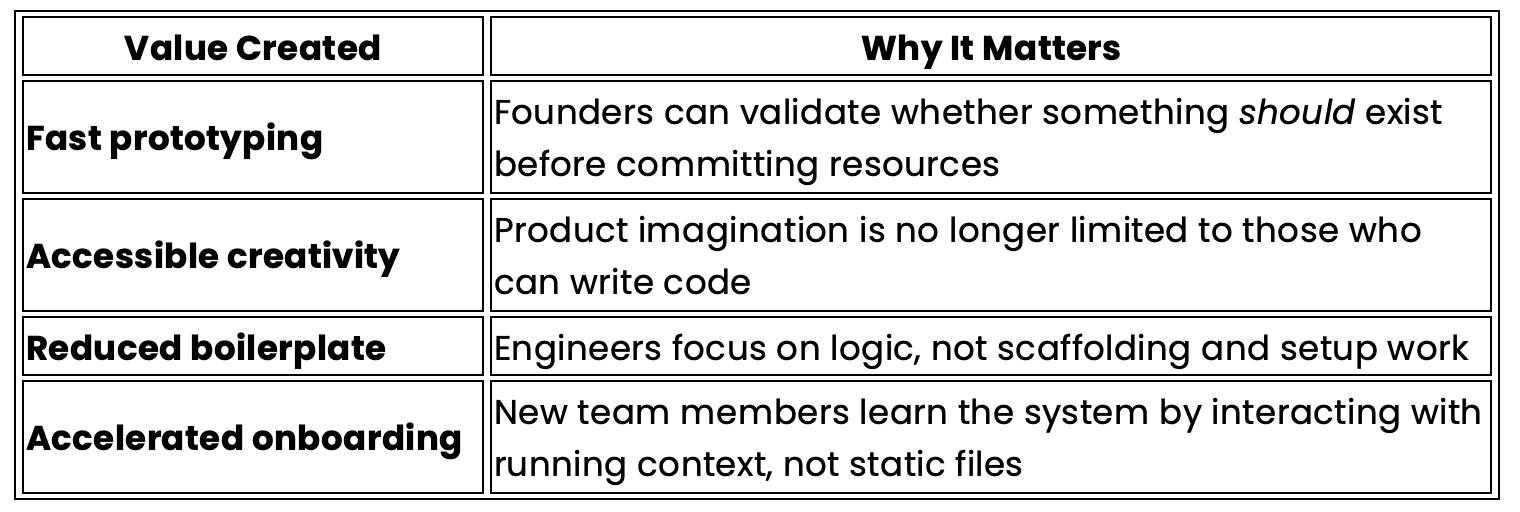
In the 0 → 1 phase — when the goal is to explore, learn, and iterate — vibe coding is a genuine accelerant. It gets ideas into the world faster. It reduces the cost of experimentation. It enables momentum.
But 0 → 1 is not where most products live. It is only the beginning.
As soon as a system needs to support real usage — real data, real concurrency, absolute reliability, real compliance, fundamental change — the work shifts. The system must now be stable. Understandable. Observable. Governed. It must function predictably under stress and evolve without collapsing under its own weight.
And this is where vibe-coded systems begin to strain.
The challenge with vibe-generated software is not that it fails immediately. Quite the opposite. The UI loads. The workflows behave. The database responds. To a non-technical stakeholder, it looks done.
But prototypes succeed when everything goes right. Production systems succeed when things go wrong.
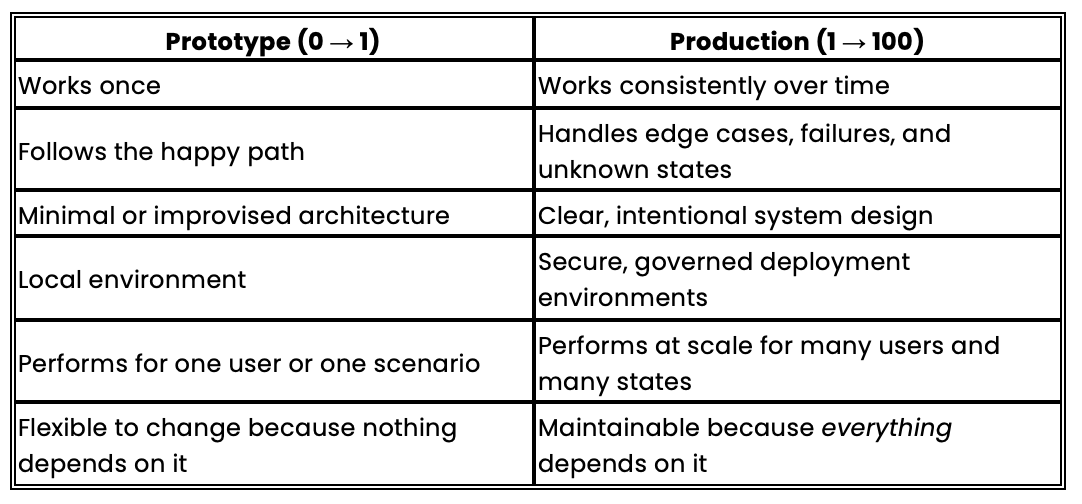
Vibe coding accelerates the left side of the table — the visible portion of the system.
But the right side — the invisible infrastructure that allows software to last — is where engineering lives.
This is why many teams are now hitting what some have begun calling “code bankruptcy.” The moment when continuing to patch and extend a vibe-built prototype becomes more expensive than rebuilding it from scratch. Not because the prototype was poorly made — but because it was never designed to scale.
When growth arrives — more users, more workflows, more data, more compliance obligations — architecture is no longer optional. Without it, even functional software eventually collapses under the weight of complexity.
The belief that AI will replace engineering assumes that the hard part of software is writing code. But code generation has never been the limiting factor in software development — not for teams building systems that support real users, real workflows, real data, and real change over time.
The complexity of software lives beneath the surface layer of code. Code is the expression. Engineering is the reasoning.
Engineering is the discipline of deciding:
For any system beyond a prototype, the real challenges emerge in the structure, not the syntax:
These are the decisions that determine whether a system is:
And these decisions cannot be made by simply generating more code.
Because code is only correct in context. And context is where judgment lives.
Today’s LLMs are powerful pattern engines. They can produce code that looks right based on examples. But they do not yet:
They do not ask:
These are engineering questions — not code generation prompts.
As AI accelerates software development, the importance of systems thinking increases, not decreases.
Speed amplifies decisions. And poorly reasoned decisions compound.
Organizations that treat AI as a substitute for engineering will quickly become fragile. The organizations that treat AI as a force multiplier for thoughtful engineering will move quickly toward advantage.
The difference is not how fast you can generate code. The difference is whether the system you’re building can survive its own success.
The point is not to dismiss vibe coding. It is genuinely transformative. It has changed who gets to build, how quickly ideas can be tested, and how early teams learn what is worth investing in. It has opened the door wider — and that is progress.
But progress requires discernment. Because the place where vibe coding shines is not the place where real systems live for long.
The right question isn’t “Should we use vibe coding?”
The right question is “Where does vibe coding create value — and where does it create risk?”
When the goal is speed, discovery, creativity, and proof of possibility, vibe coding unlocks real advantage:
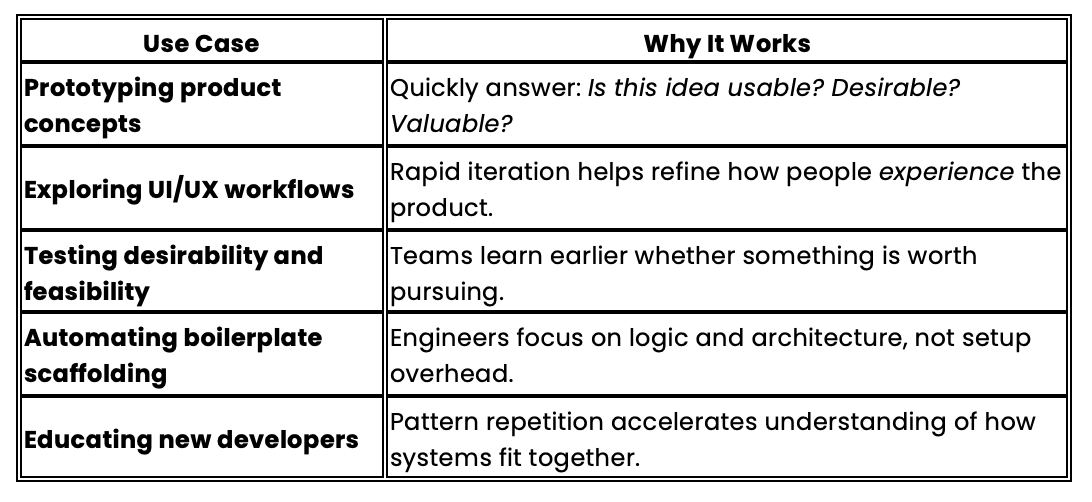
In these scenarios, the risk of rework is expected, and the goal is learning, not longevity.
Speed matters more than structure.
This is where vibe coding is a true accelerant.
Once a system needs to scale, integrate, secure data, or support operational workflows, the assumptions change:
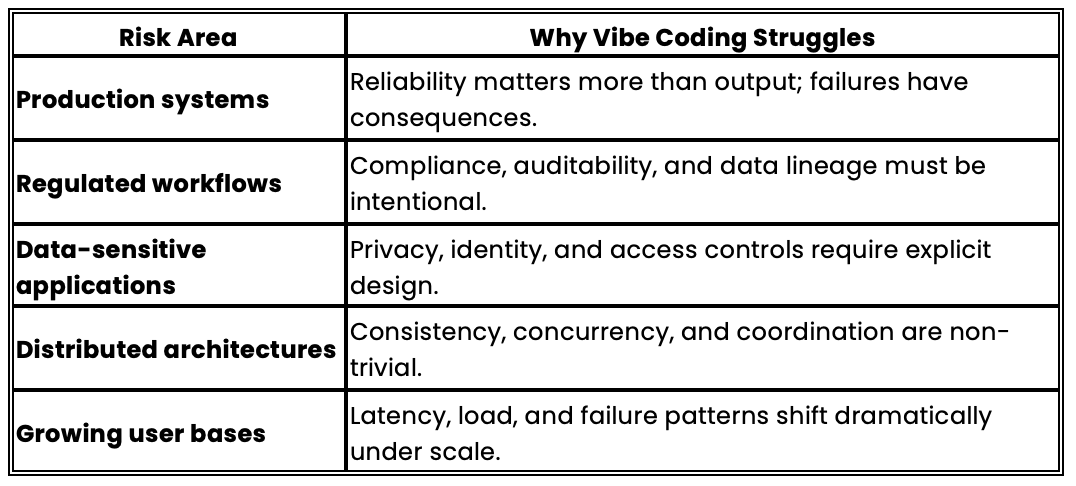
In the 1 → 100 phase, the goal becomes durability, clarity, governance, and repeatability.
This is where vibe-coded scaffolding begins to bend under its own weight.
Because scaling is not just more of the same. Scaling is different by nature.
Vibe coding answers the first question beautifully. It cannot answer the second.
And most organizations don’t live in 0 → 1 for long. The moment users show up, the system must:
And those qualities don’t happen at the prompt layer.
They happen at the architecture layer.
Most organizations don’t struggle at the idea stage. They struggle when the idea needs to grow.
The real inflection point is 1 → 100 — the stage where systems evolve from a working demonstration into a product that must be reliable, governed, observable, secure, and maintainable. This is where vibe-generated scaffolding starts to show strain. And this is where Concord operates.
Concord helps organizations transform early experiments, piecemeal solutions, and rapidly generated prototypes into cohesive, extensible platforms designed to support growth — not just possibility.
We don’t replace speed.We make speed sustainable.
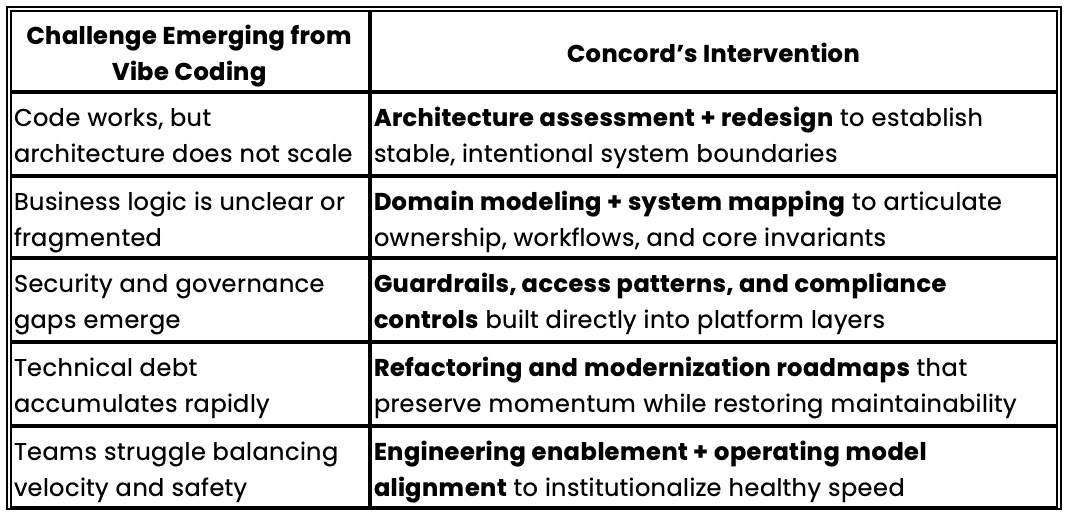
We don’t slow teams down. We remove the friction that would eventually slow them down anyway.
Our approach is built on three pillars that align with how modern systems evolve:
This is the difference between building quickly and building something that can last.
We don’t stop teams from using AI. We help them use AI in a way that compounds value instead of eroding it.
Because the future is not AI instead of engineering. The future is AI accelerating engineering — when guided well. Learn more about building sustainable, AI-accelerated systems in our next blog post.

Not sure on your next step? We'd love to hear about your business challenges. No pitch. No strings attached.


